Top Three Housing Helpers
We've taxed, banned, regulated and choked housing from happening. Politicians and pundits as well as academics who who don't build housing blamed "flippers, foreign buyers, investors, short-term rental providers and speculators" which drove the popular public and media discourse, a false narrative.
Ironically, Canadians regularly watch many popular home-flipping shows on HGTV, subsidized by our provincial and federal government tax credits. Canadians are also the largest source of foreign buyers of US real estate. Think snowbirds who own condos down south.

-
Political promises of hundreds of thousands of new housing targets were just clever public relations spin. The truth? The numbers of new homes actually built were woefully inadequate compared to the millions of people invited here annually through mass immigration, much higher than any G7 country.
-
And Canada is now building even fewer homes. Toronto new homes under construction are the lowest in 30 years. Many housing projects (thousands of "approved" homes) in Metro Vancouver won't get built, or went into receivership.
Below are three top solutions, proven to tackle housing challenges.
1) Approve Housing Faster
Time Costs Money.
-
Governments talk about "speeding up" approval processes then add even more regulations, like "green building" that multiply costs by millions. California just froze new building regulations for
-
Mandate municipal housing approval times to weeks, not years. Longer approval times mean higher (carrying) costs for builders of about eight to 10% a year, such as mortgage interest, annual property taxes, insurance, professional consultants, labour, etc. Some builders even pay "empty homes taxes" for boarded up, rat-infested dwellings on a site awaiting demolition and building permits for apartments.
-
"While senior governments talk a big game, they allow municipalities to maintain a system that makes building homes next to impossible. In the Greater Toronto Area, the average approval timeline for a new housing project is a staggering 20 months. In Vancouver, it can take longer to get a project approved than to actually build it.," a market research analyst wrote in National Post. Now homebuilders are taking governments to court for their costly delays!
-
More solutions here.

2) Reduce Fees/Taxes
Taxes and Fees are Demolishing Housing Plans
-
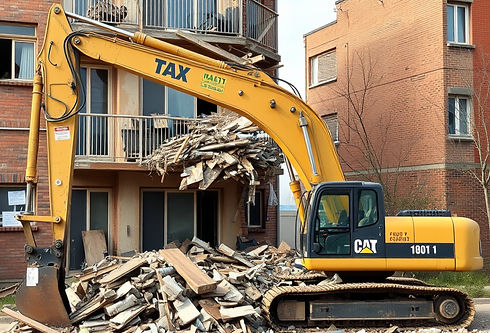
Reduce taxes, fees and red tape on home builders and rental providers, which are demolishing housing targets and political goals across Canada. Did you know the federal government charges builders GST on rental housing with a complex set of rules to apply for partial rebates? Just remove GST entirely. Magic will happen.
-
Try tax incentives instead. Proof: Kelowna built thousands of new rental homes and lowered rents with a 10-year property tax exemption.
Brampton says it will reduce fees up to 100% to stimulate rental home building. More solutions here.
3) Remove Rent Controls
Rent controls prevent new home building and limit repairs to older apartments.
Remove rent controls (government-set caps on annual rent increases) for new apartments. Alberta has none, meaning higher vacancy rates (more choice) and lower rents. A healthy vacancy rate is 3% or above. National vacancy rates for secured rental apartments (purpose-built) range from about 1% to 2%.
-
Quebec and Ontario removed some rent controls. This stimulates new building and helps rental providers keep up with rising property repair costs, insurance premiums & taxes that grossly exceed government rental increase limits.
-
Proof? A respected survey of economists on the left and right of political spectrum agree rent controls are destructive. Ninety-three per cent agreed rent controls impact the "quantity and quality of housing" available.
-
A Toronto-based public policy analyst studied Sweden's rent control disaster where tenants wait as long as 14 years for an apartment. Assar Lindbeck, Stockholm University economics professor famously noted: “In many cases, rent control appears to be the most efficient technique presently known to destroy a city—except for bombing.”
More solutions here.

Hear from home-builders, tax experts, academics & opinion leaders
Being featured here or any website page does not imply formal membership in the coalition or endorsement.


What's Behind our Housing Crisis?
From costly, ideological "green building" schemes for virtue-signaling labels like LEEDS PLATINUM that fail to deliver the energy benefits they promise, to additional policies that drive up costs for builders and buyers, learn more by watching the below videos. Read the professional engineer Greg Wilson's summary.
Is Green Building a Grift?
Green Building Overpromises and Underdelivers
Greg Wilson, a professional engineer, describes how "green building" is a false premise that adds significant costs to housing and other projects without delivering the promised energy benefits.
Architects, builders, and politicians worship at the green altar of LEED, a false god. LEED was created in the late 1990s by the US Green Building Council (USGBC) as a way to promote energy-efficient construction techniques. To receive a LEED plaque, a building must earn points for various environmental attributes. Over time, these points have expanded beyond high-efficiency furnaces and triple-glazed windows to include a variety of clearly political objectives, such as the promotion of electric cars, public transit, and “social health and equity.
-
Rising Costs and Delays: government-mandated environmental standards—such as LEED (Leadership in Energy and Environmental Design) Gold or Platinum—drive up public infrastructure budgets and cause project delays. Studies show the additional construction costs range from 2% to 20%.

-
And that doesn’t include fees charged by LEED-certified specialists to scrutinize project plans. Seattle-based architect Galen Page says: “It costs US$250,000 on a fairly small project to just monitor and document the LEED process.” He encourages his clients to focus on more practical matters. He avoids green roofs in all his plans. The best roof, he noted, is a sloped metal design that removes water and snow quickly and efficiently. It may not earn any LEED points, but it’s cheap and keeps the building underneath dry.
-
Case Study (Saanich, B.C.): A planned $26 million replacement for Fire Station Two (approved in 2019) hit major snags and budget issues. Saanich city council had to up the budget to $44.6 million, arguably the most expensive firehall ever constructed in Canada. Because local council mandated LEED standards and trendy mass timber construction, the project is years delayed.
-
Questionable Performance: Expensive "green" features—such as mass timber framing or green vegetated roofs—often fail to deliver promised long-term energy savings and can suffer from practical flaws, like roof leaks and complex maintenance. LEED status is no guarantee of green performance. Certification is awarded before construction and is based on modeling projections. A 2009 study by the National Research Council of Canada found LEED status was often irrelevant to observed building performance, given that “28–35% of LEED buildings used more energy than their conventional counterparts.” A 2020 report commissioned by BC Housing and the University of Victoria examined 10 social housing projects certified LEED Gold. Only two met or exceeded their modeled results. “The other eight consumed between 22.1% and 281.7% more energy than models predicted,” the report found.
-
Taxpayer Burden: these initiatives are ideological "grifts" that prioritize trendy sustainability labels and political posturing over practical engineering, fiscal responsibility, and functional public infrastructure.

Watch the Green Building video for a summary. Full article in C2C Journal.