Taxes & Fees Hidden in Housing Prices & Rents
Taxes and fees on housing are growing unsustainably, funding greedy government bureaucracies with ballooning management ranks that add more red tape regulations that stifle homebuilding efforts.
A recent red tape study by the Business Council of Canada found a wait of "nearly 250 days to get a building permit." Canada’s regulatory burden has grown by 37% since 2006, to over 321,000 requirements.
-
Endless, new regulations also add costs! This East Van home builder, Avi, said in a viral tweet that city staff required his "simple" bathroom renovation submit an expensive tree expert report.
-
Vancouver single-family home buyers face government fees, charges and regulatory costs that are “63 per cent of the final sale cost,” according to the 2023 CD Howe report. That amounts to $1.3M of an average sale-priced $2M home. "Homes in the Toronto area now cost homebuyers $350,000 extra over the cost to build."


-
This Nanaimo, BC resident criticized his city's decision to double development fees, impacting first-time buyers especially. "Council should do the right thing and remove all punitive development fees. The province should cut land transfer taxes on affordable housing. Then watch the boom in developments of affordable homes."
-
Below are charts of taxes/fees by all FOUR levels of government on typical rental and condo homes in British Columbia. And these charts are a couple years old! Fees have only increased since then.
-
A new economic analysis finds: "The biggest cost in the price of a new home is taxation, making the three levels of government the top beneficiary of the construction of a new home.
-
Taxes and fees now comprise an average of about 35.6 per cent of the price of a new home, which is 16 per cent (or five percentage points) higher than at the start of the decade. About 70 per cent of those charges are for development charges for sewer, water and electricity, land-transfer taxes, and HST. The other 30 per cent is for the indirect income and corporate taxes paid throughout the supply chain, but ultimately passed on to buyers." -National Post Sept. 29/25
-
Around 73,000 "approved" homes in Metro Vancouver are stalled before construction because they're now too costly to build, buy or rent.
-
Missing Middle Housing founding director Mike Moffat states in the Hub: "If we want to make quality homes affordable to the middle class again, we need to stop taxing them out of existence. Cut the cost of homebuilding, or face the double blow of fewer homes and 100,000 lost jobs.
-British Columbia Housing Charts below from Property Tax Professional Paul Sullivan, Ryan ULC.
Government Cost:
$368,511 or 29.25% Vancouver Two-Bed

Government Cost:
$79,877 or 12.97% Kelowna Two-Bed

Rental Taxation: Vancouver


Metro Vancouver Government Sewage Fee up 235%
The regional government sewage fee (Development Cost Charge) for a new apartment in Vancouver was $6,249 last year. From $13,392 this year, it's being hiked to $17,873 in 2026 and $20,906 in 2027. That’s a 235 per cent fee increase on builders, passed on to buyers and renters.
“We’re taxing new homes at the same rate, relatively, as we do cigarettes,” said Kevin Layden, president and CEO of Wesbild Holdings Ltd. in BIV News.
Ontario's Fees Hidden in Housing
“Development charges increase the cost of homes for everyone. They are a housing tax. During a housing crisis, we don’t think you should raise taxes on housing,” said Housing Minister Sean Fraser of the City of Ottawa’s decision to increase development charges by up to 13% in May.
-
In 2024, Toronto raised development charges on each home (unit) twice, totalling a 40% increase when homebuilding and sales had slowed.

This chart shows how much civic governments are choking off housing with massive fee hikes. This does not even include all the various taxes by other levels of government embedded in the final cost to buy or rent.

-
Provincial and federal government taxes on housing are also worsening affordability. Millions of homes Canada needs aren't being built due to these rising costs. We're going backwards on housing starts, reports the National Post. "Canada Mortgage and Housing Corporation (CMHC) recently forecast that the total number of housing starts this year will be about 237,800, down from 245,367 in 2024. The agency also forecasts a drop to about 227,734 next year and 220,016 in 2027." (This is despite the "13-billion investment" in housing promised by Prime Minister Carney, expected to deliver only 26,000 homes over five years according to the federal watchdog Parliamentary Budget Office that also noted it's well short of the 700,000 homes needed by 2035 to restore affordability.
-
Ottawa journalist Randall Denley wrote: "The most effective solution to high housing prices is painfully obvious, but neither the provincial nor federal government is willing to act. A new home priced at $1 million includes $130,000 in federal and provincial sales taxes. Buyers don’t see the charge because it’s embedded in the home price. Both levels of government are willing to spend billions on what they hope will be housing solutions, but they are unwilling to stop taxing housing, ignoring the well-known wisdom that if you want less of something, tax it. It’s time to axe the tax."
-
One city government is showing leadership. The City of Brampton, Ontario just announced it will reduce or eliminate fees on apartments for rentals by up to 100%. In 2018, a Brampton developer would have been charged $54,197 for a larger apartment. That fee is now over $100,000. -Storeys News
First-Ever Canada Mortgage
& Housing (CMHC) Fee Study
This is the first time CMHC has collected this development charge data on new homes, validated by CMHC analysts.
Focused on 30 municipalities in Ontario, British Columbia, Alberta and Quebec, all source data is here.
Interesting that the city of Vancouver (with enormous fees) was not included.
These development charges, levied by regional and municipal governments on builders, account for a significant part of the cost of a new home in some cities. Development charges are supposed to be used to fund community infrastructure (like schools, transit, hospitals, sewage plants or roads).
A separate study of Vancouver fees and charges on a typical high-density building in an existing built-up urban area in Vancouver rose 290 per cent from $18,901 per unit in 2010 to $73,772 in 2025, according to an Oct. 9 report commissioned by NAIOP, a commercial real estate development association, featured in BIV News.


The report by Keleher Planning & Economic Consulting Inc. said government charges accounted for only 10.2 per cent of construction costs per home in 2010 but 20 per cent in 2025. Vancouver’s fees and charges now equate to 28.1 months of rent, more than double the 12.8 months from 2010, it said. Notably, this study did not include property-related taxes by all governments.
Are all these government fees, charges, taxes and regulatory burdens too high a cost? And where is all that money going? And are these funds being well-managed? Taxpayers aren't seeing many new daycares, hospitals or schools for the billions being taken from homebuilders.
The new sewage treatment plant being managed by the Metro Vancouver regional government in North Vancouver is billions over budget while an independent audit has been shelved. Are all these various fees and charges levied on homebuilders simply building more bureaucracy...?

Time for Transparency?
Transparency is needed in real estate sales and rental contracts for buyers and renters.
Ken Grafton, a Quebec writer for the Hamilton Spectator and The Chicago Tribune and
Marc Denhez , an author, lawyer, and Canadian Institute of Planners award winner wrote about this recently.
"We can blame the housing crunch instead on foreign investors or on owners who leave their property vacant or who convert housing to B&B, but the reality is that public sector policies contribute directly to the high cost of housing in Canada.
In Canada, sales taxes on ... food and clothing — when applicable at all — are transparently listed on the consumer’s bill of sale; but most of the buffet of taxes and charges on housing, ... never make their way to the consumer’s Agreement of Purchase & Sale. They are buried in the “supply chain” never to be seen again, except in the inflated total figure at the bottom of the page."
- Building.ca, Jan. 9, 2024 Cash Cow: Government taxes and fees on new housing

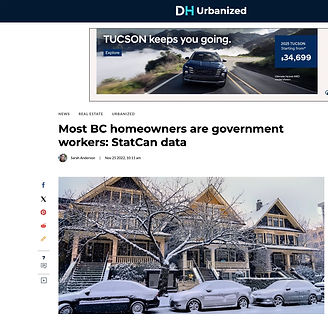
Housing Fact: Most Homeowners in BC Work for Governments
A recent Statistics Canada study confirmed MOST HOMEOWNERS IN BC are government workers,
not foreign buyers, not flippers,
not speculators, not short-term rental owners.
So stop the blame game and let's make it easier to build homes for everyone who chooses to live here.
That means reducing government fees all home-seekers pay.
Housing Cash Cow?
Isn't it time to tell governments to stop using homes like bank machines or cash cows?
That's why you can't afford to buy or rent a new home.
Make them listen or future generations will also be denied home ownership. Share if you care!
Other Canadian cities have set an example by reducing fees on homebuilders. Last November 2024, Vaughn, Ontario reduced development charges by 88 to 92 per cent. That's a savings of up to $44,000 per home that buyers won't have to pay.
At least the City of Vancouver may finally be getting the memo their fees are too high as many "approved" homes aren't getting built due to growing costs of construction.
"Amid a crash in the condo market, halted projects, tariffs and escalating construction costs, Vancouver City Council approved a package of changes aimed at offering developers some relief, especially for multiunit projects," the Globe and Mail recently reported.
Plans to help incentivize Vancouver homebuilding include:
-
an allowance for higher rents to help cover costs
-
a temporary 20% reduction in development fees
-
a break on builder fees to fund public art among others.
City of Vancouver's 2026 Development Fees


The City of Vancouver just updated its development fee schedule for 2026.
Fees can be as high as millions of dollars for housing, all passed on to you the buyer or renter in the end.
See page 7 of the zoning and development fee schedule.
On top of those government-imposed fees are many more, all hidden in the costs of housing.
"Corrie Okell, (Vancouver's) general manager of development, buildings and licensing, will ask (Vancouver City) council to increase permit fees by 4.5 per cent in 2026.
These fee hikes include development permits, plumbing permits, demolition permits and mechanical permits.
Permit fees have increased by 23 per cent over the past three years." - MSN News.
While the federal government reduced GST on purpose-built rental buildings, that savings got wiped out by Metro Vancouver's decision to hike Development Cost Charge fees, says urban planning expert Michael Mortenson in his blog When one government cuts, another collects.
Metro Vancouver Regional Government's High Housing Fees Hurt Owners and Renters Alike

Metro Vancouver Regional Government Development Cost Charges levied on homebuilders have seen a 10x INCREASE by 2027, says community planning expert Michael Mortensen on Linkedin, terming this "insane".
"Over the last 20 years, the cost to develop an apartment in Vancouver has increased >3X; government taxes, fees and levies grew >7.5X; while local household incomes have risen only 1.7X."
New West City Councillor Daniel Fontaine levied his own criticism squarely at the regional government for its bloated bureaucracy and unaccountable spending: "Metro Vancouver has evolved from a basic regional utility into something much larger: a sprawling bureaucracy that now dabbles in housing, economic development, and park operations. It’s an empire with Crown-sized budgets but little of the oversight or media scrutiny that provincial Crown corporations face. That needs to change.
Residents deserve a say in whether they want to continue with a structure where local appointees make billion-dollar decisions with minimal transparency, or move toward a directly elected body that answers to the public.
Metro Vancouver’s mandate should also be narrowed back to its core utilities – water, liquid waste, and solid waste. These are the essential services families rely on every day. Straying into broader initiatives risks diluting focus and driving up costs. Residents expect reliable services, not empire building."
Construction costs are the highest he's seen in 22 years: Polygon Homes Executive Vice-President
A new analysis of homebuilding costs before and after Metro Vancouver’s recent fee hikes shows many projects are no longer financially viable, as profiled in Storeys.
Polygon Homes VP Robert Bruno says he’s never seen costs this high in his 22 years at the company: “Our costs are the highest we’ve ever seen, and we don’t expect them to fall soon.” His letter also calls for a review of Metro Vancouver.
An independent review by Coriolis found many projects across the Lower Mainland are now unfeasible under the new fees.
Home builders raised these concerns in a January letter to Metro Vancouver, noting the hikes are stopping projects cold.
While the City of Vancouver temporarily lowered its fees to spur construction, those savings are wiped out by the regional government increases. Watch the Global News video below for more.

Economist Gives BC & Ontario
a Failing Grade on Provincial Housing Report Card
Unsurprisingly, BC and Ontario—Canada’s least affordable housing markets—also levy some of the highest, most harmful fees. Both earned a failing grade on the provincial report card by economist Michael Moffatt, Founding Director of the University of Ottawa’s Missing Middle Initiative and Ivey Business School professor.
“New Brunswick is Canada’s top performer,” Moffatt said, with PEI close behind. Ontario and BC finished last. In the Coast Reporter, he noted Atlantic provinces “get the basics right” with low fees, fast approvals, and fewer roadblocks.
Reflecting on his first home purchase, Moffatt said taxes on new homes have priced out the middle class. In 2004, he paid under $16,000 in taxes/charges on a $168,000 home; today, those fees exceed $110,000, and in the GTA can top $300,000.

A Housing Affordability Comparison
Canada versus USA Major Cities
Hanif Bayat, PhD, CEO & founder of WOWA.ca, a Canadian personal finance platform analyzed for the Globe and Mail housing affordability in major cities across the USA and Canada. He compared typical Benchmark Home Prices, Median Incomes, Population and calculated the Affordability Ratio (Home Price divided by Income).
Vancouver and Toronto were at 1st and 3rd place in the top three most unaffordable cities, much of that driven of course by governments, fees, taxes and regulatory costs. These costs have only increased over the last decade as governments merely "talk" about addressing housing affordability issues as a hundred thousand jobs were lost in construction and real estate over the past year 2025. New housing isn't being built because the costs of construction are too high. Blame governments at all levels.